The 3-Day Dumbbell Plan for Busy Guys (Full 8 Weeks, One Pair of Dumbbells)
Three 40-minute workouts a week, one pair of dumbbells, eight weeks mapped out in full — including the week where most guys quit.
Not medical advice. I'm a regular guy sharing what worked for me — not a doctor, trainer, or dietitian. Full disclaimer
On this page8 sections
I've started more workout programs than I can remember and finished very few of them. The one that finally stuck — the one that turned me from a serial quitter into a guy who's trained consistently for years — was embarrassingly simple: three days a week, one pair of dumbbells, about 40 minutes a session, in my garage. This article is that program, written out in full, with the parts most program write-ups skip: what it costs, how long each session really takes, and exactly where it almost fell apart.
Quick honesty checkpoint before the sets and reps: I'm not a trainer, and this isn't a program I invented from research — it's a basic full-body template that's existed forever, arranged around a normal work schedule. Three full-body days happens to line up nicely with official guidance, since the CDC's physical activity guidelines call for muscle-strengthening activity on 2 or more days a week plus regular aerobic activity. This plan clears the strength bar with a day to spare. If you're wondering how the cardio side fits in, I broke the full guidelines down in plain English in the CDC numbers, translated.
What you need
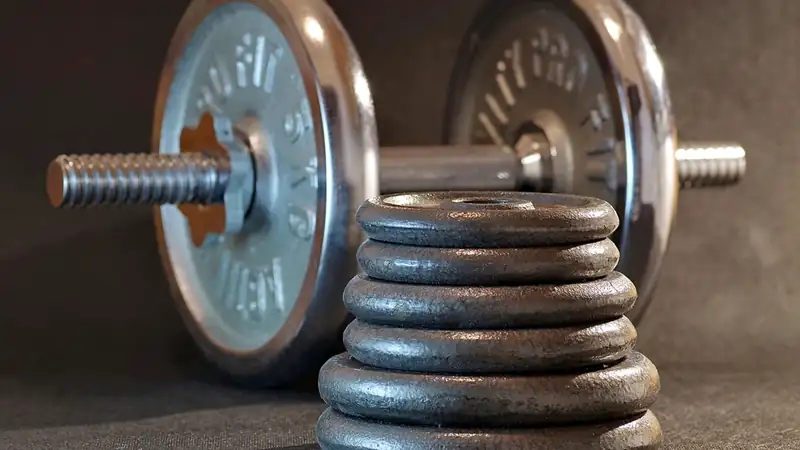
One pair of adjustable dumbbells, or a couple of pairs of fixed ones. That's it. I ran my first eight weeks with a single pair of 25 lb (11 kg) adjustables I bought used for $40. If you're starting from zero equipment, my $150 home gym article covers the exact buy list and where to save. A bench is nice but not required — every movement here works from the floor or standing.
Time commitment, measured with a stopwatch across my own logs: 36 to 44 minutes per session including warm-up. Three sessions is roughly two hours a week. That's the real price of this program, and it's the number to say out loud when you're deciding whether you'll actually do it.
The plan
Three days, non-consecutive. Monday/Wednesday/Friday is the classic, but Tuesday/Thursday/Saturday works the same. Each day is a full-body session with five movements: a squat pattern, a hinge, a push, a pull, and a carry or core finisher. You alternate two workouts, A and B.
| Order | Movement | Sets | Reps | Rest |
|---|---|---|---|---|
| A1 | Goblet squat | 3 | 8–12 | 90 sec |
| A2 | Two-dumbbell Romanian deadlift | 3 | 8–12 | 90 sec |
| A3 | Floor press (or push-up if the weight's too light) | 3 | 8–12 | 90 sec |
| A4 | One-arm dumbbell row | 3 | 10–12 each side | 60 sec |
| A5 | Farmer carry | 3 | 40 yards (or 40 sec march in place) | 60 sec |
| Order | Movement | Sets | Reps | Rest |
|---|---|---|---|---|
| B1 | Reverse lunge (dumbbells at sides) | 3 | 8–10 each leg | 90 sec |
| B2 | One-leg hip hinge (light, focus on balance) | 3 | 8–10 each leg | 60 sec |
| B3 | Standing overhead press | 3 | 6–10 | 90 sec |
| B4 | Bent-over two-dumbbell row | 3 | 8–12 | 90 sec |
| B5 | Dead bug (bodyweight) | 3 | 8–10 slow reps each side | 45 sec |
The weekly pattern just alternates: week one is A-B-A, week two is B-A-B, and so on for eight weeks. Warm up with five minutes of easy movement — I do jumping jacks, arm circles, and one light set of each of the first two exercises. Nothing fancy.
How to progress with one pair of dumbbells
This is the question everybody asks, because you can't add five pounds to a fixed dumbbell. Here's the progression ladder I used, in order:
- Add reps. Start every movement at the bottom of the rep range. When you can hit the top of the range on all three sets, move to step 2.
- Slow the reps down. Three seconds lowering on every rep makes the same weight meaningfully harder. This alone carried me through weeks three to five on squats.
- Shrink the rest. Cut 90-second rests to 60. Same weight, harder session.
- Add a set. Three sets become four on the movement that's gotten easy.
- Change the leverage. Two-dumbbell movements become one-dumbbell versions: goblet squats become front-foot-elevated split squats, floor presses become slow push-up variations, rows get a pause at the top.
Only after all five steps are exhausted do you actually need heavier dumbbells — for me that took right around the full eight weeks on lower body, and longer for pressing.
What eight weeks actually looks like
Every program promises transformation. Here's what my log actually says, and what I'd tell a friend to expect:
Week 1
- Sessions feel awkward — you'll spend time checking form, not grinding sets
- Soreness for 2–3 days after each workout, especially legs
- Goblet squats with 25 lb feel surprisingly humbling
- Zero visible change, and that's normal
Week 8
- Sessions run on autopilot; 40 minutes, no phone-scrolling gaps
- Soreness mostly gone except after new variations
- Rep quality is the visible win: deeper squats, controlled rows
- Clothes fit differently before the mirror agrees — most guys feel the difference around week 3 and start seeing it around week 8
That "feel it at three, see it at eight" line isn't marketing — it's the honest timeline from my own logs and from every regular guy I've compared notes with. Anyone promising visible abs by week four is selling you something.
Where this program almost died (twice)
I quit this exact program twice before it stuck. Both failures happened the same way, and neither had anything to do with the sets and reps.
What changed on the third attempt: I wrote the three sessions into my calendar like meetings, at 6:30 a.m. before anyone needed me, and I adopted a one-rule policy — a missed workout is skipped, never rescheduled. Miss Wednesday? The next workout is Friday, as planned, no guilt homework. That single rule is most of why the program survived, and it's a big enough topic that I wrote a whole piece on the week-3 wall and the scheduling fix that saved it.
Three details standard write-ups skip
The floor press problem. Without a bench, floor pressing with light dumbbells gets easy fast. The fix isn't buying a bench — it's push-up progressions. Feet-elevated push-ups with a 3-second descent are harder than most guys' floor press and cost nothing.
Grip runs out before legs do. By week four, Romanian deadlifts stopped challenging my hamstrings because my hands were the weak link. Solution: do your carries last (grip is fried anyway), and hook the thumb over the fingers. If your dumbbells have knurled handles, you'll get an extra month before this matters.
The 15-minute fallback version
The one-week test drive
Don't commit to eight weeks. Commit to one. Do A on Monday, B on Wednesday, A on Friday, at a time you've written down like an appointment. Total cost: about two hours and whatever your dumbbells run. If Friday's session happens, you've already beaten the version of you that quit last January — and the next seven weeks are just the same week, repeated with slightly better numbers.
Keep reading
One-Kettlebell Basics
One cast-iron bell, six movements, three days a week. Here's the honest buying advice, the swing lesson everyone learns the hard way, and the full program.
Couch to 5K, Honestly
I quit Couch to 5K once and finished it once. The difference wasn't fitness — it was knowing about the cliff at week 5 and the rule that repeating a week isn't failing it.
Desk Job Counters
You can't out-plan nine daily hours of sitting with three gym visits a week. Here are the five counters I actually run, sourced, scheduled, and priced at zero dollars.