Kettlebell Basics: 6 Movements, One Bell, Full-Body Program
One cast-iron bell, six movements, three days a week. Here's the honest buying advice, the swing lesson everyone learns the hard way, and the full program.
Not medical advice. I'm a regular guy sharing what worked for me — not a doctor, trainer, or dietitian. Full disclaimer
On this page6 sections
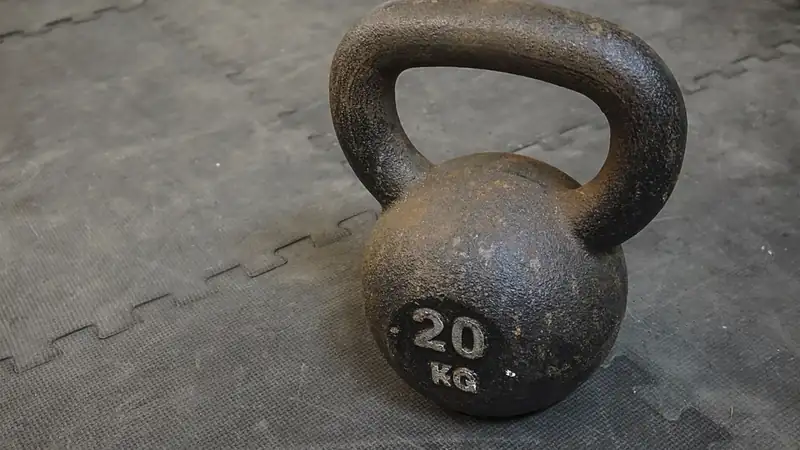
Full disclosure before a single swing: I've written on this site that a kettlebell mostly duplicates what an adjustable dumbbell already does, and I stand by it — if you own dumbbells, the bell is a want, not a need. So why a whole kettlebell article? Because the duplication argument runs both ways. One kettlebell also covers most of what a beginner's home gym needs, and there's a real population this tool fits better than anything else: the guy who inherited a bell from a garage sale or an abandoned January, the guy with a truly tiny apartment, the guy who wants exactly one object to own and zero decisions to make, and the guy who tried dumbbells and found them boring but finds swings weirdly fun. Fun is an underrated programming variable.
I bought my bell as a "fourth purchase" — exactly the slot I assigned it in the bands-vs-dumbbells-vs-barbell comparison — and it earned a permanent spot in my rotation. This is the field guide: what to buy, the six movements that constitute 90% of useful kettlebell training, the one form lesson that protects your back, and a full three-day program.
Buying: one bell, cast iron, boring
The weight. For a guy who's done some lifting — a few months of dumbbell work, say — the standard starting recommendation is around 35 lb (16 kg), and my experience agrees. If you're starting from genuinely zero, 25–30 lb is the honest call: the swing will still challenge you, and the press definitely will. Buying too light is the classic error in the other direction — a bell you can press twenty times teaches nothing, and unlike adjustable dumbbells, a kettlebell has exactly one setting.
The price. Cast iron runs the familiar $1.50–2.00 per pound at normal retail, so a 35 lb bell lands around $50–65 at big-box stores and Amazon-tier brands, with sale prices dipping under $40 if you're patient (budget brands' 35-pounders have floated below $30 on deep promotions this year). Skip anything with a vinyl coating that hides casting quality, anything "adjustable," and anything with a screen. The technology being purchased here is a cannonball with a handle; it was finished two centuries ago.
The one lesson that is most of kettlebell training: the hinge
Every kettlebell injury story I've personally heard — including my own week-two back grumble — comes from the same misunderstanding: treating the swing as a lift (arms raise the bell) or a squat (knees bend deep) when it's actually a hinge — hips travel backward, shins stay near vertical, and the bell moves because your hips snap forward, not because your arms vote. The arms are ropes. The hips are the engine.
Learn it in this order, which is the order that kept my back happy on the second attempt: master the kettlebell deadlift first (hinge down, grab bell, stand up — no momentum) for a week until the hips-back pattern is automatic. Then add the snap. The swing is just that deadlift pattern performed with intent. Ten minutes of deadlift patience saves the classic self-taught-swinger's sore back — mine lasted four days and taught me the entire curriculum.
The six movements
- Deadlift — the foundation and the teacher. Hinge, grab, stand.
- Two-hand swing — the signature. Conditioning and posterior chain in one crackling package.
- Goblet squat — bell held at the chest; the same squat that anchors my dumbbell plan, and the bell's shape actually holds nicer.
- One-arm press — shoulder work plus an honest core test; the offset load makes your midsection do quiet overtime.
- One-arm row — the pull, hinged and braced, each side.
- Suitcase carry — walk with it on one side, switch. Grip, posture, and core, disguised as walking.
That's a squat, a hinge, a push, a pull, a carry, and a conditioning engine — every major muscle group the CDC's strength guidance asks you to hit on 2+ days a week, from one object that lives under a side table.
The program: three days, ~30 minutes
| Day | The work | Rounds | Rest |
|---|---|---|---|
| A | Goblet squat ×8 · one-arm press ×6/side · one-arm row ×10/side · suitcase carry 30 sec/side | 4 | 60–90 sec between rounds |
| B | Deadlift ×8 · two-hand swing ×12 · goblet squat ×6 · carry 30 sec/side | 4 | 60–90 sec |
| Finisher (optional, either day) | Swings on the minute: 10 swings at the top of each minute, rest the remainder | 5–8 min | Built in |
Progression with a fixed weight follows the same ladder as fixed dumbbells: add reps within reason, then slow the grinding movements (squats, presses — not swings; ballistic lifts stay crisp), then shrink rests, then add rounds. The swing progresses by density instead: more swings inside the same finisher minutes. When the 35 lb bell finally goes quiet — months out for most guys — the classic step is a second, heavier bell around 53 lb (24 kg), and that's a purchase your log will justify by itself.
A week from my actual log
Because programs on paper always look tidier than programs in a garage, here's what a random recent week of this rotation actually looked like. Monday, Day A at 6:30 a.m.: all four rounds, but the fourth press dropped to five reps a side because the third round got greedy — logged, not mourned. Wednesday, Day B: full session plus the finisher, six minutes, sixty-two total swings, ending in the few-words-only zone with the garage door open to a cold morning. Friday: the calendar collapsed, so the session became the two-round minimum version at lunch — twelve minutes, done in work-adjacent clothes, no finisher, appointment kept. That's the real texture: one honest session, one good one, one shrunken one, zero skipped. The bell's contribution to that math is that setup time is literally the time it takes to pick it up — on the day the routine wanted to fail, there was no barbell to load or gym to drive to, just a cannonball with a handle sitting eight feet from my desk, offering no excuses to borrow.
What one bell honestly can't do
Balance requires the case against, so: pressing strength outgrows a single bell fastest — a 35 lb press gets easy months before a 35 lb swing does, and there's no dial to turn. Pure size-building is slower on low-variety, fixed-load tools. And precise progression tracking is coarser than with adjustables — "more reps, less rest" is real progress but fuzzier math. None of this is fatal for the first six-to-twelve months, which is exactly the window this program is for. If the bell gets you through that window still showing up, you'll have earned the nicer problem of choosing what's next — more bells, the dumbbell path, or a gym membership your habits can finally cash.
The pitch, honestly sized: about $55, one object, six movements, three half-hour sessions a week, and both halves of the federal guidance covered once the finisher's in play. The kettlebell isn't magic — nothing on this site is — but it might be the single highest ratio of program-per-object in fitness, and for a certain kind of guy, owning exactly one uncomplicated thing is the feature that finally makes the habit stick.
Keep reading
Couch to 5K, Honestly
I quit Couch to 5K once and finished it once. The difference wasn't fitness — it was knowing about the cliff at week 5 and the rule that repeating a week isn't failing it.
Desk Job Counters
You can't out-plan nine daily hours of sitting with three gym visits a week. Here are the five counters I actually run, sourced, scheduled, and priced at zero dollars.
The 20-Minute Lunch Workout
The hard part isn't fitting a workout into lunch. It's walking into your 1 p.m. meeting afterward looking like nothing happened. Here's the session built for that.