"Planet Fitness to Powerlifting Gyms: What Each Gym Tier Costs and Who It Fits"
The real question isn't which gym is best — it's which gym you'll still be walking into in March. Every tier priced, with the fine print.
Not medical advice. I'm a regular guy sharing what worked for me — not a doctor, trainer, or dietitian. Full disclaimer
On this page8 sections
I've held memberships at four different tiers of American gym: a $10 budget chain, a $45 mid-tier club, a brief and financially regrettable stint at a premium fitness resort, and my current $55 strength gym. Each one taught me something about what you're actually buying — and about the gap between the advertised price and the real one.
This is the tier map I wish I'd had at the start. Prices are current as of August 2026, pulled from chain websites and my own local Charlotte-area quotes. Gym pricing varies by location and promotion, so treat every number as a midpoint, not a quote. One framing note up front: any tier here satisfies what official activity guidance actually asks of you — the CDC's targets are two strength days plus regular aerobic activity, achievable in literally all of them (or at home for $150, or on the sidewalk for free). You're not buying health outcomes with a bigger membership. You're buying equipment, environment, and — more than anything — a place you'll actually keep showing up.
Tier 1: Budget chains ($10–30/month)
The players: Planet Fitness, Crunch base tier, EōS, Blink, Fitness Connection.
What you get: rows of cardio machines, machine circuits, dumbbells typically up to 50–75 lb, and at some chains no barbells or squat racks at all (Planet Fitness famously has Smith machines instead of free barbells).
Who it fits: beginners, cardio-and-machines guys, anyone for whom price is the deciding factor between a membership and nothing, and travelers (Black Card–style tiers include any-location access). It's a genuinely great deal for a guy running a simple machine circuit twice a week. Who it quietly doesn't fit: anyone who wants to learn barbell lifts. Not judging the fluorescent-purple ecosystem — I trained in it happily for a year — but you can't practice squats in a gym without a squat rack.
Tier 2: Mid-tier clubs ($30–60/month)
The players: LA Fitness, Gold's Gym, Crunch's upper "Peak" tiers, 24 Hour Fitness, YMCA (which deserves special mention: $45–70/month at most branches, but with income-based pricing, pools, and childcare that make it the best family value in America).
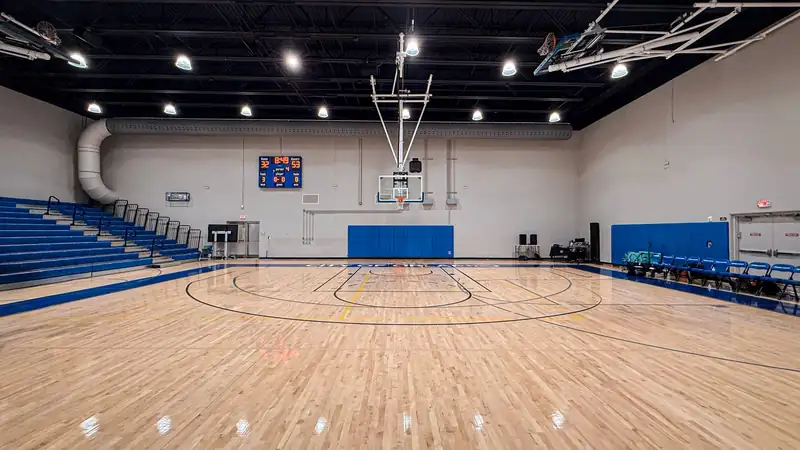
What you get: everything the budget tier has plus free-weight areas with real barbells, squat racks, benches, heavier dumbbells (usually to 100–120 lb), group classes, basketball courts at many locations, and usually a pool at the top of the tier.
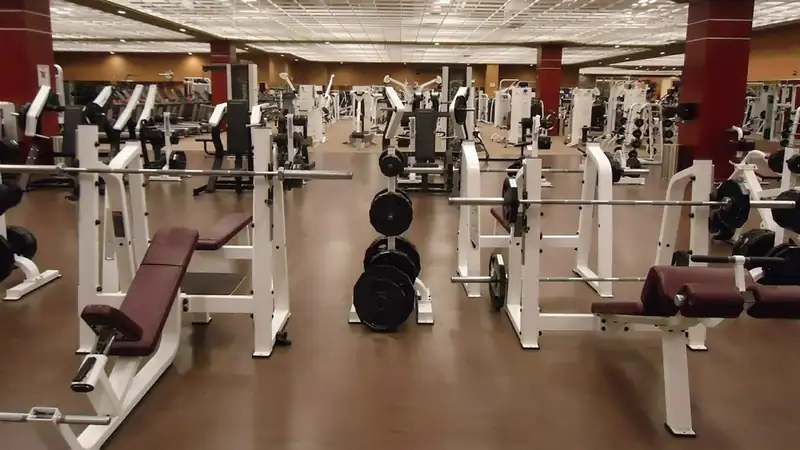
Who it fits: this is the correct default tier for most guys reading this site — anyone running a real strength program with barbell or heavy dumbbell work, guys who want a class schedule for accountability, families (YMCA especially). The mid-tier is where my 3-day dumbbell plan graduates get the most equipment per dollar.
Tier 3: Premium clubs ($80–250+/month)
The players: Life Time ($120–250+ depending on club), Equinox ($200–400), club-level one-offs in big metros.
What you get: genuinely beautiful facilities — spas, saunas, pools, towel service, cafes, extensive classes, childcare, and equipment nobody's waiting for. It's a country club where the golf is deadlifts.
Who it fits, honestly: people who will live there. The premium tier makes sense when the gym replaces other spending — your coffee shop, your coworking space, your family's pool membership — and the whole household uses it several times a week. As a place to do three strength workouts? You're paying $2,000+ a year for amenities you'll use twice. My four-month premium experiment taught me a $150/month lesson: the sauna doesn't do the squats for you. I canceled and didn't miss it, which was informative.
Tier 4: Specialty strength gyms ($40–90/month)
The players: independent powerlifting and strongman gyms, weightlifting clubs, CrossFit boxes (a cousin of this tier at $120–200/month, classes included).
Real pricing: most independent barbell gyms run $40–80/month; mine is $55. Usually month-to-month, minimal fine print, no annual fee — small businesses tend to price like humans.
What you get: calibrated bars, bumper plates, specialty bars, chalk that nobody yells at you about, deadlift platforms, maybe zero treadmills — and, the real product, a room full of people who take training seriously and will teach you things. No pool. Sometimes no air conditioning, which the members will describe as a feature.
The whole map on one chart
How to test-drive a gym without getting sold
Every tier offers some version of a free pass — a day at most budget and mid-tier chains, a week if you ask, and small strength gyms will almost always give you a drop-in visit for $10–20 or free. Use them, but use them right, because the tour is a sales instrument and the guest visit is reconnaissance. Three rules from my four sign-ups:
- Visit at YOUR hour, not theirs. A gym at 2 p.m. Tuesday is a showroom; the same gym at 5:45 p.m. is a queue for every rack. If you'll train at 6 a.m. or 6 p.m., scout at 6 a.m. or 6 p.m. The only question that matters is whether the equipment you need is free at the time you'll actually be there.
- Do your real workout on the pass. Not a wander — the actual session from your program. You'll learn in 40 minutes whether the dumbbells go heavy enough, whether there's floor space for carries, and whether the vibe makes you want to return. That last one is data, not vanity: you're evaluating a room you need to walk into 150 times a year.
- Decline the tour close politely and wait a week. Every chain gym's best price appears after you leave without signing. The follow-up email with the waived initiation fee is so reliable it might as well be on the price sheet. Small gyms don't play this game, which is itself a point in their favor.
The fine-print checklist (read before signing anything)
- Annual fee: amount and billing date. This is the industry's favorite hidden $50–80.
- Cancellation method: month-to-month or contract? A few chains still require certified mail or an in-person visit to cancel. In my experience the difficulty of cancellation correlates suspiciously well with how much a gym is betting you'll stop coming.
- Initiation fee: waivable roughly always. Ask, or wait two weeks for the promo.
- The 20-visit math: divide the monthly all-in by your honest expected visits. A $15 membership used twice is $7.50 a visit; a $50 membership used 12 times is $4.17. The cheap gym is only cheap if you go.
So which tier?
The pattern from my four memberships: the right gym is the one that removes your personal excuse. If your excuse is money, the budget tier exists so that $15 can't be the reason. If it's equipment, mid-tier kills that for $45. If it's motivation, a strength gym or class-based box buys you a community that notices your absence. And if your excuse is the commute itself, the winning gym might be the $150 one in your garage. Buy against your failure mode, not against the amenity sheet — the March version of you is the customer, not the January version.
Keep reading
Gym Anxiety Field Guide
Feeling like everyone's watching you at the gym isn't a character flaw — it's the default setting. Here's the field guide I wish someone had handed me: hours, scripts, and a four-visit plan.
Track This, Ignore That
Years of logs taught me that most fitness numbers are noise wearing a lab coat. Here's the one-question test, the four metrics that pass it, and the five that don't.

Getting Back After a Layoff
Nobody quits fitness once. The pattern that kills comebacks is the same every time — and the fix is a two-week on-ramp your ego will hate and your March self will thank you for.